FAQ for Divers
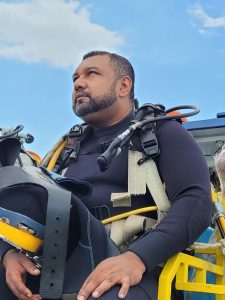
A Career as a Commercial Diver
A career as a commercial diver is both challenging and highly specialized. In places like Singapore, the profession is regulated to ensure safety due to the high-risk nature of underwater work.
What Does a Commercial Diver Do?
Commercial divers typically work in industries such as:
- Offshore oil and gas
- Marine construction
- Ship repair and maintenance
- Underwater inspection and welding
- Salvage operations
The work can involve deep-sea diving, operating heavy equipment underwater, and working in low-visibility or hazardous environments. Physical stamina, mental resilience, and strict adherence to safety protocols are essential.
Minimum Requirements in Singapore
To become a commercial diver in Singapore, you must meet the following baseline requirements:
- Be at least 18 years old
- Medical Fitness
- Possess a current Commercial Diving "Fit to Dive" medical certificate.
- The certificate must be issued by a hyperbaric and diving medical specialist registered in Singapore.
- Regular medical examinations are required to ensure ongoing fitness.
- Recognised Certification
- Obtain a Certificate of Training in Commercial Diving.
- The certificate must be recognised by Singapore's Ministry of Manpower (MOM).
Is It the Right Career for You?
Commercial diving can be rewarding due to:
- Competitive pay
- Opportunities to work on major infrastructure and offshore projects
- Travel and international assignments
- A strong sense of accomplishment
However, it is not for everyone. The job often involves:
- Long hours
- Physically strenuous work
- Strict safety compliance
- Working in confined or hazardous underwater environments
If you are physically fit, comfortable working underwater, and thrive in disciplined, high-pressure environments, commercial diving can be a fulfilling long-term career.
Diving Medical Certificate
Medical Fitness Requirement for Commercial Divers
- Mandatory Certification
- All commercial divers shall possess a valid and current “Fit to Dive” medical certificate issued by a duly qualified hyperbaric and diving medical specialist.
- Scope of Certification
- The medical certificate must expressly state that it is issued for the purpose of commercial diving, occupational diving, or an equivalent designation. Medical certificates issued solely for recreational diving shall not be accepted for commercial diving activities.
- Validity Period
- Unless otherwise specified by the issuing practitioner, the medical certificate shall remain valid for a period of one (1) year from the date of the medical examination. Upon expiry of the stated validity period, the certificate shall be deemed invalid, and the diver must undergo a further medical examination and obtain a renewed certificate before engaging in any commercial diving operations.
- Registration of Medical Practitioner
- The medical practitioner issuing the certificate must be lawfully registered to practise medicine in Singapore.
- Reference Guide
- Divers may refer to the CDA(S) Guide entitled “Diving and Hyperbaric Medical Practitioners,” available under the “Downloads” tab, for guidance.
- Disclaimer Regarding Practitioner Listings
- The aforementioned guide is published by the Commercial Diving Association (Singapore) (“CDA(S)”) and contains only the names of medical practitioners whom CDA(S) members are currently consulting and have recommended for inclusion. The guide does not constitute a complete or authoritative listing of all Diving and Hyperbaric Medical Practitioners in Singapore. A comprehensive register of medical practitioners may be obtained from the relevant statutory medical registration authority.
If you are New to Commercial Diving
Requirements to Become a Commercial Diver in Singapore
- Approved Training & Certification
- You must complete a commercial diving course recognised by Singapore's Ministry of Manpower (MOM).
- A Certificate of Training from an accredited course is required.
- Types of Courses
| Level | Course Type | Details |
|---|---|---|
| Level 1 | Inland/Inshore Commercial SCUBA (CSCUBA) Diver | No decompression, up to 30m |
| Level 2 | Inland/Inshore Surface-Supplied Diving Equipment (SSDE) Diver | Up to 30m |
Source: Commercial Diving Competency Standards (Workplace Safety & Health Council / Ministry of Manpower, Singapore)
- Accredited Training Providers in Singapore
- Accredited by Singapore Accreditation Council (SAC) to ISO 29990:
Training Provider Contact KBA Training Centre Pte Ltd [email protected] Subsea International Training Associates [email protected]
- Accredited by Singapore Accreditation Council (SAC) to ISO 29990:
- Funding / Subsidies
- Singapore Citizens and Permanent Residents (PRs) may be eligible for funding for these Singapore qualifications.
- The funding amount varies based on the terms set by the relevant government agency.
- Foreign Qualifications
- Certain foreign commercial diving qualifications (from Australia, UK, etc.) are recognised by CDA(S) & MOM.
- These courses are not subsidised.
- Refer to:
- CDA(S) Guidance Document "Recognized Diver Certificates."
- MOM Technical Notes (TN): Surface Supplied Diving Equipment (SSDE) Diver – Appendix C
- Not Acceptable for Commercial Diving
- Recreational diving certifications (e.g., PADI, NAUI, PDIC)
- Military diving qualifications
If you already are a Certified Commercial Diver
Individuals may possess commercial diving qualifications obtained outside the jurisdiction of the Ministry of Manpower (MOM), other than MOM's Level 1 and Level 2 certifications. Such individuals are advised to verify whether their qualifications are included in MOM's list of recognised foreign commercial diving certifications. This list is published in the document Technical Notes: Surface Supplied Diving Equipment (SSDE) Diver, Appendix C, available for download from the Workplace Safety and Health (WSH) Council website.
A condensed reference of recognised qualifications may also be found in the CDA(S) Guidance Document titled Recognized Diver Certificates, accessible via the "Downloads" section of the WSH Council website.
Where a foreign qualification is formally recognised by MOM, the holder thereof may commence or continue employment as a commercial diver in Singapore without the requirement to complete MOM's Level 1 and Level 2 commercial diving courses.
If you are an Uncertified but Experienced Commercial Diver
Stop diving at once and act responsibly. You may be one of the active commercial divers in Singapore who has been working as a diver for many years, but never had the opportunity to attend a course of training and instruction at a recognised commercial diving training centre.
This can be a problem because a certificate of training as a commercial diver is a MOM requirement, and is non-negotiable, regardless of how many years of experience you may already have. One way to get yourself certified in line with MOM requirements is to undergo an "experienced diver programme" which is acceptable to MOM.
In Singapore, this would be the "Assessment Only Pathway" (AOP) programme, currently available at the commercial diver training centre listed above. The "assessment" (not a course!) lasts 10 days (compared to the 40 days for a full Level 1+2 course) and results in a recognised Level 2 equivalent i.e. the "Level 2: Surface Supplied Diver – Assessment Only Pathway" qualification. Bear in mind that, if your experience is very limited (e.g. only SCUBA diving), you will not be able to pass the Assessment. In this case, we recommend you attend the full course.
If you are unsure, you can arrange to meet with the course provider for a frank discussion on your suitability for the AOP programme. Some foreign certifying bodies (e.g., ADAS in Australia) also offer an experienced diver programme to obtain an Offshore Diver certificate. However, these programmes are only for those with extensive offshore diving experience. Again, if you are unsure, you should contact the training centre involved to check your eligibility.
If you want to be Commercial Diving Supervisor
- Mandatory Training for Commercial Diving Supervisors
A Commercial Diving Supervisor must complete an accredited course at a Learning Service Provider (LSP) to obtain an Inland/Inshore Diving Supervisor certificate recognized by the Ministry of Manpower (MOM), Singapore.
The relevant courses are:
| Level | Course Name | Scope |
|---|---|---|
| Level 3 | Inland/Inshore Commercial Self-Contained Underwater Breathing Apparatus (CSCUBA) Dive Supervisor | No decompression dives, up to 30 m |
| Level 4 | Inland/Inshore Surface-Supplied Diving Equipment (SSDE) Dive Supervisor | Dives up to 30 m |
-
- These courses are aligned with the Commercial Diving Competency Standards set by the Workplace Safety & Health Council and MOM.
- Courses are available at accredited LSPs.
- Funding options exist for Singapore Citizens and Permanent Residents.
- Recognition of Foreign Qualifications
- Some foreign dive supervisor certifications are recognized by CDAS & MOM.
- Example: IMCA Air Dive Supervisor qualification.
- A full list of accepted foreign qualifications is in the MOM Technical Notification (TN).
- Assessment Only Pathway (AOP)
- Currently, there is no Assessment Only Pathway for experienced Dive Supervisors in Singapore.
- All candidates must complete the formal course at an LSP.
If you want Additional Commercial Diving Certifications
Legal and Regulatory Perspective on Additional Certifications for Commercial Divers
Once a diver has completed the mandatory commercial diving training recognized by government authorities, additional certifications or qualifications may be pursued. These are generally optional but can enhance safety, competence, and employability.
- Core Diver Certification – Legal Requirement
- Mandatory Proof of Training: Divers must hold a certificate or accreditation recognized by the relevant authority (examples: CDA(S), ADAS, HSE).
- Purpose: Establishes legal eligibility to perform commercial diving operations under occupational safety and maritime regulations.
- Requirement: Always maintain a copy of your certificate or diver accreditation card to present to regulators, employers, or inspection authorities.
- Trade Association Memberships (Optional)
- Legal Status: Not a substitute for government-recognized diver certification.
- Example: CDA(S) Competency Card, Diver Card from CDA(S).
- Benefit: Offers recognition and networking within the commercial diving industry; may be referenced in regulatory audits as evidence of continued professional development.
- Additional Skills Qualifications (Optional but Often Regulated)
- Specialized diving skills may be regulated by occupational health and safety authorities and are usually required by employers for specific operations:
- Underwater NDT Inspectors – For inspecting infrastructure while adhering to safety regulations.
- Underwater Welding – Must follow government occupational safety standards.
- Underwater Cutting/Burning – Compliance with safety protocols is mandatory.
- Specialized diving skills may be regulated by occupational health and safety authorities and are usually required by employers for specific operations:
- Surface Support Qualifications (Optional but Safety-Critical)
- Certain roles supporting diving operations may have government-regulated standards:
- Diver Medic Technicians – Often required to meet occupational health certifications.
- Life Support Technicians / Chamber Operators – Must follow decompression and hyperbaric regulations.
- Dive Equipment Technician & Dive Helmet Service Technician – Equipment maintenance may be subject to statutory safety inspections and standards.
- Certain roles supporting diving operations may have government-regulated standards:
A Note on Divers' Log Books
Many countries require professional and commercial divers to maintain an accurate, up-to-date Diver's Log Book as part of occupational safety regulations.
The log book serves as a legal document that may be inspected by regulatory authorities, such as maritime safety agencies, enforcement / legal departments, or occupational health and safety inspectors.
Failing to maintain a log book can lead to fines, suspension of diving certification, or legal liability in case of an accident or fatality.
A Professional Commercial Diver's Log Book can be purchased from your course provider, or you can check one of the equipment suppliers listed under "Associate Members", in the "Contact Us" webpage.
A Note on Expired & Fraudulent Certificates
Many certificates in this industry come with expiry dates, and will become invalid once expired. It is important to monitor these dates closely and arrange for renewal or recertification in advance to avoid any lapses in compliance.
Do not alter, edit, falsify, or fabricate any certificate, medical certs or records. Falsified or fraudulent certificates are illegal under the Workplace Safety and Health (WSH) Act, and those responsible may face fines and/or imprisonment.
It is increasingly common for companies and clients to verify certificates and even Log Books. The likelihood of detection is high, so maintaining authenticity is critical. By keeping all records legitimate, you can build a long-standing career with a solid professional reputation in the industry.
Industry & Union Support
Any individual seeking employment as a commercial diver in Singapore is invited to submit their curriculum vitae ("CV") to the Commercial Divers Association (Singapore) ("CDA(S)"). Upon receipt, CDA(S) may forward such CVs to its member companies for their consideration. Notwithstanding the foregoing, applicants who have a specific company in mind retain the right to contact such company directly using the contact information provided on the "Contact Us" page of the relevant entity.
Divers, or any persons engaged in the commercial diving industry, who have concerns relating to safety may contact CDA(S) for guidance and advice. In circumstances of immediate or urgent safety concerns, it is recommended that such individuals contact the Ministry of Manpower ("MOM") directly through the MOM Safety Hotline at 6317 1111.
In the jurisdiction of Singapore, commercial divers are classified within the sector of Shipbuilding and Marine Engineering. Accordingly, commercial divers seeking representation or support in matters relating to salary, employment conditions, or other industrial relations issues may consult with the Shipbuilding and Marine Engineering Employees' Union ("SMEEU"). Membership in SMEEU is offered at a reasonable fee and provides, in addition to representation in employment matters, eligibility for training grants and access to certain benefits provided through NTUC-affiliated retail outlets. Prospective members may contact SMEEU directly or via CDA(S) using the contact information provided on the respective "Contact Us" pages.
Application of CDA(S) Competency Card
The CDA(S) Competency Card serves as an additional identification for commercial divers engaged in operations within inland and inshore waters of Singapore. An application for the CDA(S) Competency Card shall be submitted in accordance with the eligibility criteria prescribed under the Ministry of Manpower's (MOM) recognised standards. Applicants are required to demonstrate compliance by producing either a valid training qualification issued by a CDA(S) and MOM-recognised training provider, successful completion of an assessment-only pathway, or equivalent foreign qualifications recognised by the Ministry.
Applications must be accompanied by all requisite supporting documentation, including but not limited to proof of training qualification and a recent photograph, and shall be subject to the payment of the prescribed application fee. The Competency Card, upon issuance, shall remain valid for a specified period, after which renewal may be affected upon demonstration of continued compliance with the competency standards and regulatory requirements established by MOM.
General Provisions
CDA(S) reserves the right to amend, suspend, or revoke the Card in accordance with applicable regulations and standards, including where the holder fails to maintain the requisite competency or breaches any provisions of these Regulations.
For more information do download the application form here